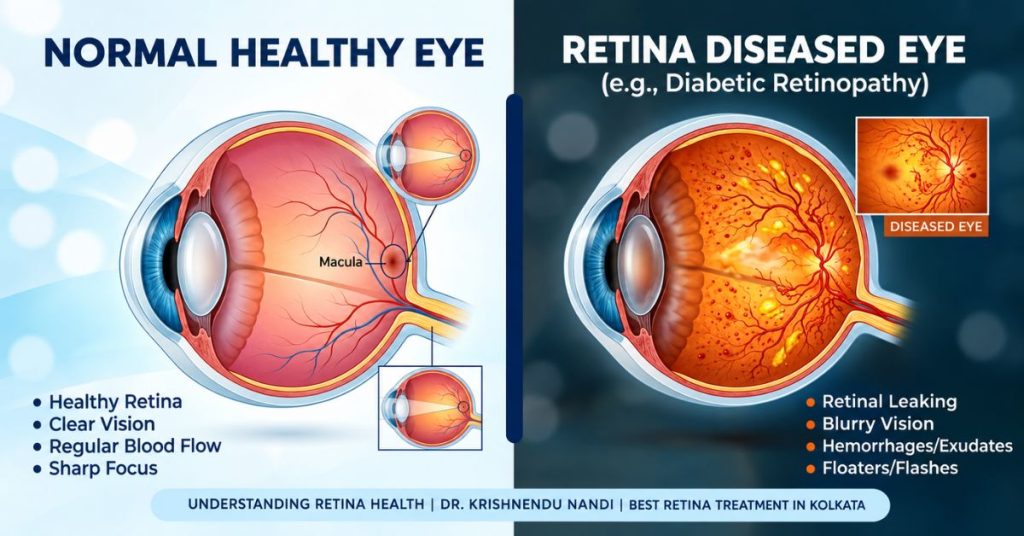
Just like the film or sensor in a camera, the retina captures images. Light, on entering the eye, strikes the retina. The retina transforms this light into messages which travel to the brain via the optic nerve. The brain then interprets these signals and enables us to see.
The middle of the retina is called the macula. It controls the sharpness of the central vision. A healthy macula is essential for the ability to read, recognise faces, drive and see small details.
Damage to the retina or macula may cause vision to change. Certain types of retinal disease may be gradual, and some may occur rapidly. This is the reason periodic check-ups of the eyes are important, particularly for individuals with diabetes or excessive myopia, high blood pressure or eye issues.
Patients searching for the Best Retina Treatment in Kolkata should seek out a retina specialist who has a solid understanding of the retina and can properly diagnose the issue and suggest the treatment based on the condition. In this regard, Dr Krishnendu Nandi is a great choice.
The retina is the location of many diseases. Some are associated with the ageing process, while others result from diabetes, vascular complications, physical trauma, or structural changes within the eye.
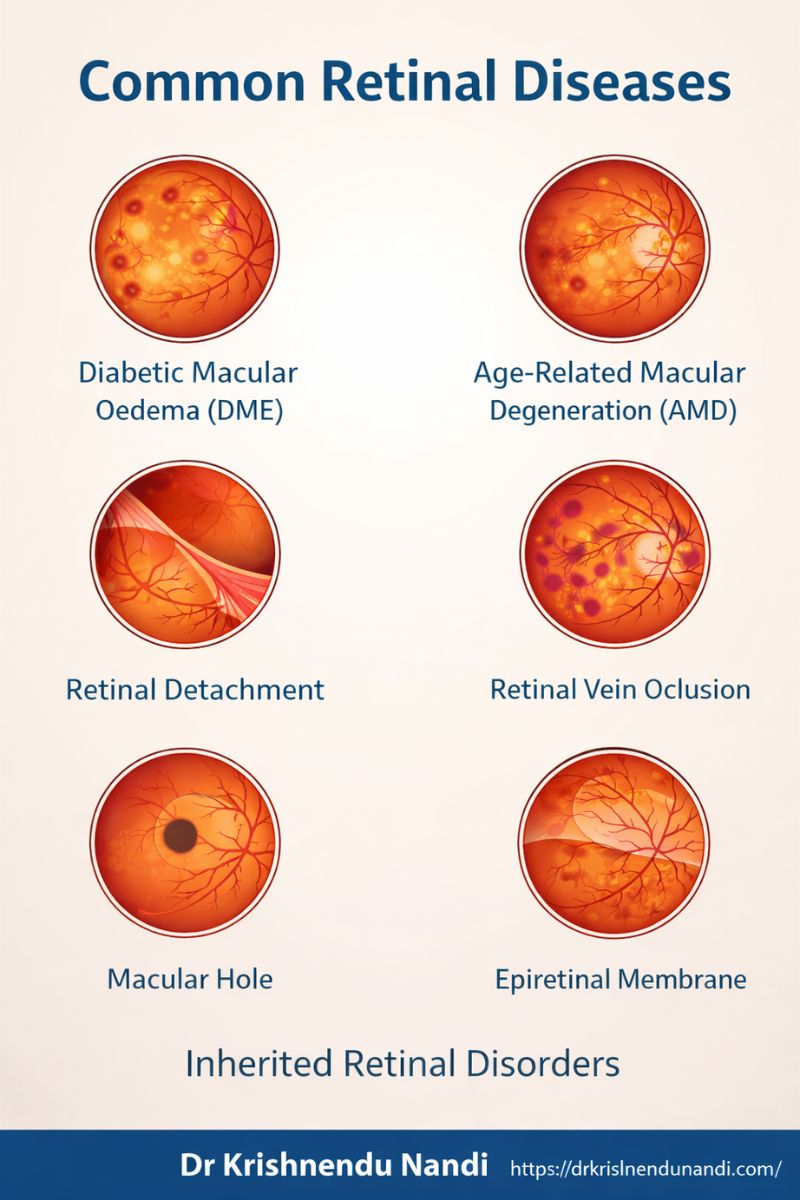
Diabetes may cause damage to the small blood vessels of the retina. As it progresses, it can lead to bleeding and swelling of the retina with resulting vision changes.
Damaged blood vessels can cause fluid to build up in the macula. This can impact the ability to see what is directly in front of you.
Lesion of the macula may cause problems with central vision.
When the retina pulls away from its place. Requires immediate medical treatment.
A small hole can form in the macula and may interfere with normal central vision.
A thin layer of tissue can develop on top of the retina, resulting in blurred or distorted vision.
Physical tears in the retinal layer that, if untreated, can progress to complete detachment.
Many retinal conditions remain asymptomatic in their earliest stages. However, key warning signs should never be ignored as early detection is crucial for saving visual health:
A sudden increase in eye floaters appearing as tiny spots, threads, or web-like structures in your field of vision.
Sudden flashes of light or sparks appearing in one or both eyes, often most noticeable in dark environments.
Blurry, hazy, or distorted visual field making straight lines appear wavy or bent.
Formation of new blind spots, dark gaps, or grey patches within your central or peripheral sight.
A dark shadow or curtain-like veil pulling across your field of vision from any direction.
Sudden, unexplained, and significant reduction or total loss of vision in one or both eyes.
Diabetes is one of the most significant systemic conditions affecting long-term eye health. Chronic high blood sugar levels damage the tiny microvasculature nourishing the retina, leading to serious diabetic eye complications.
In its initial stages, Diabetic Retinopathy (DR) often develops silently without obvious visual symptoms. As the condition worsens, damaged retinal blood vessels may leak blood or fluid into the eye, causing progressive vision changes.
Another major complication is Diabetic Macular Oedema (DME), which occurs when fluid accumulates in the central portion of the retina (macula). This swelling impairs sharp central vision, making everyday tasks like reading or recognizing faces difficult.
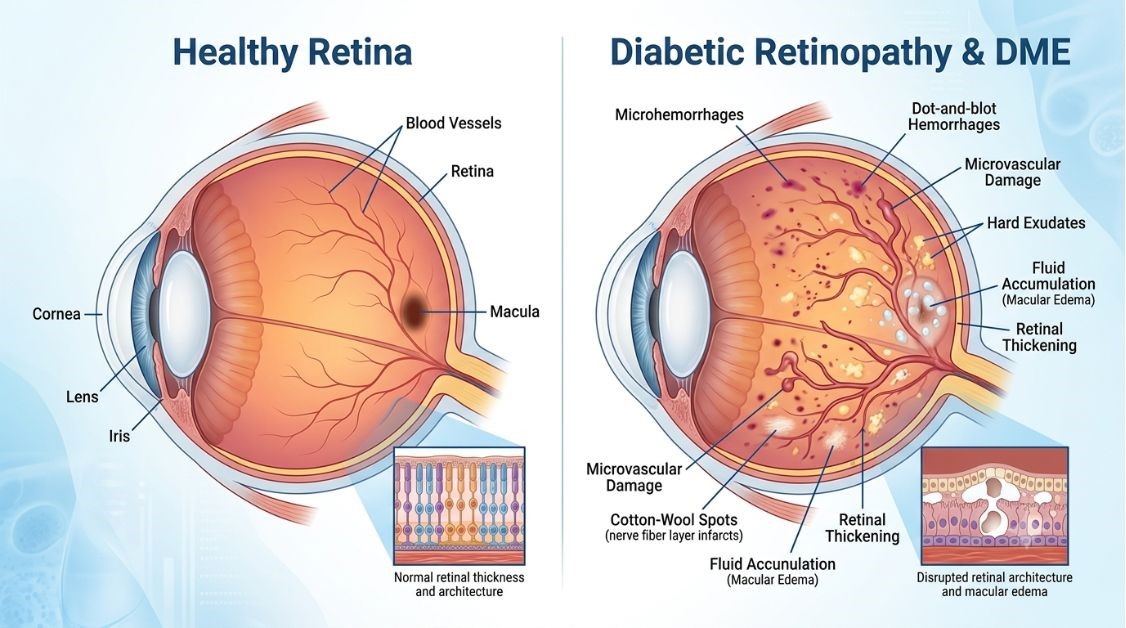 Figure: Comparison between healthy retinal tissue and diabetic microvascular damage.
Individuals living with diabetes should undergo annual dilated eye examinations—even if their sight feels completely normal. Early detection by a vitreoretinal specialist allows for timely intervention before permanent vision loss occurs.
Dr. Krishnendu Nandi offers specialized vitreoretinal care tailored to patients suffering from diabetes-related eye conditions in Kolkata. Treatment plans are customized based on disease severity and may include:
Regular diagnostic tracking for early-stage background retinopathy.
Targeted photocoagulation to seal leaking blood vessels.
Anti-VEGF therapy to reduce macular swelling and improve vision.
Advanced micro-surgery for severe hemorrhages or tissue traction.
Retinal detachment is a sight-threatening medical emergency where the retina separates from the back wall of the eye. Warning signs frequently begin with sudden flashes and floaters caused by precursor retinal tears.
Risk Factors: Severe high myopia (nearsightedness), prior cataract or eye surgeries, physical trauma, or a personal/family history of retinal issues.
⚠️ Delaying treatment for a detached retina can result in irreversible vision loss. Prompt consultation with a vitreoretinal surgeon is essential.
The macula governs our ability to perceive fine visual details directly in front of us. Conditions affecting the macula make everyday tasks—such as reading, writing, and recognizing faces—extremely challenging.
💡 Comprehensive diagnostic imaging is necessary to differentiate between various macular conditions before outlining a personalized treatment plan.
Accurate diagnosis is the cornerstone of finding the Best Retina Treatment in Kolkata. A comprehensive evaluation by an experienced vitreoretinal specialist, combined with state-of-the-art diagnostic imaging, ensures precise detection and personalized care based on your individual medical history.
High-precision 3D diagnostic scans assist in identifying retinal conditions at an early stage.
👨⚕️ Dr. Krishnendu Nandi analyzes scan findings to plan accurate and targeted treatment for every patient.
There are several advanced options for the Best Retina Disease Treatment in Kolkata. Every retinal condition differs for each patient, which is why the care plan is tailored specifically based on the disease, its severity, patient age, overall health status, and the current condition of the eye.
Laser therapy is available for specific eye diseases and may be recommended for retinal tears, certain stages of diabetic retinopathy, and other vascular retinal issues. Laser treatments serve distinct therapeutic purposes: for instance, creating a protective seal around a retinal tear to prevent detachment, or targeting abnormal leaking blood vessels in the retina.
Intravitreal injections deliver specialized medication directly inside the eye's vitreous cavity. Anti-VEGF medications are widely utilized to treat vision-threatening conditions such as diabetic macular oedema (DME), wet AMD, and retinal vein occlusion (RVO). The total number and frequency of injection sessions are determined according to individual patient needs and therapeutic response.
Vitrectomy is a specialized, advanced eye surgery performed for complex conditions affecting the retina and vitreous. During the procedure, the clear gel inside the eye is carefully removed to provide direct access to the underlying retinal pathology. It is highly beneficial in cases of retinal detachment, vitreous haemorrhage, macular hole, epiretinal membrane, and advanced diabetic retinal disease (DRD).
👨⚕️ Expert Surgical Care: Dr. Krishnendu Nandi provides the best retina treatment in Kolkata for patients requiring specialized medical and surgical retinal care.
When it comes to protecting your eyesight from complex vitreoretinal conditions, experience, clinical precision, and academic excellence matter most. Here is why patients trust Dr. Krishnendu Nandi for the best retina care in Kolkata:
Over two decades of specialized surgical experience in managing complex diabetic retinopathy, retinal detachments, macular holes, and ocular trauma. Formerly associated as a Vitreo-Retinal Consultant at the prestigious Sankara Nethralaya.
Top ranker and Gold Medalist in MBBS (2000) and Sankara Nethralaya Fellowship (2009). Trained directly under renowned world-class experts like Dr. Lingam Gopal, Dr. Tarun Sharma, and Dr. Pramod Bhende.
A major contributor to global vitreoretinal research with over 23+ published research papers in indexed international medical journals and more than 50 scientific paper presentations worldwide.
Recipient of the prestigious ASRS Honor Award (2021), ASRS Fellowship Award (2025), AIOS Ophthalmic Videography Award, and multiple OSWB/EIZOC First Prize awards for surgical excellence and imaging.
Senior Consultant and Co-Director at Netralayam Eye Hospital. Dedicated to advancing ophthalmic science by training and mentoring numerous fellow Vitreo-Retinal surgeons across India.
Pioneer in real-world clinical evaluation of advanced intravitreal anti-VEGF therapies (Aflibercept, Faricimab, Brolucizumab, and Biosimilar Ranibizumab) for recalcitrant macular edema and AMD.
👨⚕️ Patient-Centric Approach: Dr. Krishnendu Nandi combines compassionate care with state-of-the-art micro-incisional retinal surgery to ensure maximum visual preservation for every patient.
Retina treatment costs depend on condition severity, diagnostic requirements, and chosen procedure. Below is an indicative price breakdown for common retinal consultations, diagnostics, lasers, injections, and advanced surgeries in Kolkata.
| Procedure / Diagnostic Test | Estimated Cost (INR) |
|---|---|
| 🔍 Consultations & Diagnostic Examinations | |
| Retina Specialist Consultation | ₹800 – ₹2,000 |
| Dilated Retina Examination | ₹2,000 – ₹4,500 |
| OCT Retina Scan | ₹2,000 – ₹4,500 |
| Fundus Photography | ₹2,000 – ₹4,500 |
| Fluorescein Angiography (FFA) | ₹3,000 – ₹7,000 |
| B-Scan Eye Ultrasound | ₹1,500 – ₹3,500 |
| 💉 Laser & Medical Treatments (Non-Surgical) | |
| Retinal Laser Treatment | ₹8,000 – ₹30,000 |
| Retinal Tear Laser Treatment | ₹8,000 – ₹25,000 |
| Intravitreal Eye Injection (Anti-VEGF / Steroid) | ₹15,000 – ₹80,000 |
| Diabetic Retinopathy Therapy | ₹10,000 – ₹80,000 |
| Macular Oedema Treatment | ₹10,000 – ₹85,000 |
| Retinal Vein Occlusion (RVO) Treatment | ₹10,000 – ₹80,000 |
| 🩺 Advanced Vitreoretinal Surgical Procedures | |
| Vitrectomy Surgery | ₹10,000 – ₹83,000 |
| Retinal Detachment Surgery | ₹15,000 – ₹1,00,000 |
| Macular Hole Surgery | ₹60,000 – ₹2,00,000 |
| Epiretinal Membrane Surgery | ₹80,000 – ₹2,00,000 |
| Complex / Emergency Retina Surgery | ₹1,00,000 – ₹3,00,000+ |
📌 Please Note: Prices mentioned above are estimated ranges for reference in Kolkata/India. Final treatment cost will be customized following a comprehensive clinical evaluation by Dr. Krishnendu Nandi based on your specific condition and diagnostic requirements.
Retina treatment cost in Kolkata depends on a range of diverse factors. Below are the notable elements that determine the overall expense of care:
There are several treatments for retinal issues such as DR, macular hole, retinal vein occlusion, and many others. The retina treatment cost depends directly on the specific type of disease being managed.
A simple laser procedure may be enough to treat the retina if there is an early tear in the retina; however, if the retina has a complicated detachment, then advanced surgery may be necessary.
Depending on the condition, patients can be advised to have specialized diagnostic procedures such as an OCT, OCTA, FFA, fundus photo, or a B-Scan. The total cost varies based on the specific type and number of tests required.
For non-surgical interventions, the price of intravitreal injections varies greatly according to the specific drug or brand used during treatment.
Sometimes, patients require only a single injection session, while in other cases, multiple injections are needed over a span of several months.
The costs of the various retinal procedures vary based on clinical complexity, as does the cost of vitrectomy surgery.
For some complex retinal surgeries, gas or silicone oil may be used to keep the retina securely in place inside the eye until it heals. This additional requirement impacts the overall treatment expense.
Retina treatment cost in Kolkata is also dependent on facility infrastructure, operation theater setup, and specific hospital or clinic charges.
👨⚕️ Expert Guidance: Please note that these are only some of the notable factors. It is recommended to consult Dr. Krishnendu Nandi before taking any step to receive an accurate evaluation and estimate.
Posted on Google
 Hardik
Trustindex verifies that the original source of the review is Google.
very good doctorPosted on Google Ananya ManiDr. Nandi is an excellent retinal surgeon—empathetic, patient, and genuinely attentive to concerns. He provided honest advice, recommended only the necessary test, and reassured me appropriately without any unnecessary investigations or expenses. Highly recommended for his expertise and ethical approach.Posted on Google
 ABHIJIT GANGULYHe is that best doctor of netralayamPosted on Google
 Jan BanerjeeDr Krishnendu Nandi is a skilled ophthalmologist with retina speciality. He is also pleasant and responds to questions during consultancy with a smile. I had an excellent experience with him. My retina that was torn has been skillfully repaired and my eye is back to 6/6. I recommend Dr Nandi for all retina patients.Posted on Google
 Subhabrata NandiI have been under his care since 2016, and I must say he is not only an exceptionally skilled doctor but also a very kind and compassionate human being. His behavior and attitude are exemplary. He handles highly complex vitreoretinal cases with great expertise. I have personally benefitted immensely from his treatment, and I strongly recommend him for anyone dealing with such eye conditions.Posted on Google
 Md AzimFriendly behaviour thank you dr nandi sirPosted on Google
 Sonu KumarVery nice doctor
Find answers to common queries regarding retinal health, diagnostic tests, modern treatment options, and expert surgical care in Kolkata.
👨⚕️ Need Personal Advice? If you are experiencing symptoms or need a comprehensive eye check-up, schedule a consultation with Dr. Krishnendu Nandi for expert retina care in Kolkata.
Retinal diseases cannot be ignored, as the retina is crucial for maintaining clear and functional vision. Various conditions can arise due to diabetes, aging, high myopia, vascular disorders, or direct eye injuries.
Early diagnosis aids in identifying retinal issues before they progress into severe, vision-threatening complications. Modern retinal care encompasses routine diagnostic evaluations, targeted laser therapies, intraocular injections, and advanced vitreoretinal surgery tailored to the severity of the disease.
When you notice visual changes or receive a diagnosis of a retinal condition, seeking a timely consultation with an experienced specialist is essential.
👨⚕️ Dr. Krishnendu Nandi offers specialized retinal evaluations and customized treatment plans tailored to each individual patient, providing the Best Retina Treatment in Kolkata. With accurate diagnosis, prompt intervention, and consistent follow-up, your vision can be preserved for long-term ocular health.
Consult Dr. Krishnendu Nandi for specialized retina care at Netralayam Eye Hospital. Below are the chamber timings for VIP Road and Mukundapur locations:
Address: VIP Road, Kolkata, West Bengal
| Monday | ⏰ 9:30 AM – 4:00 PM |
| Wednesday | ⏰ 9:30 AM – 5:00 PM |
| Saturday | ⏰ 12:00 PM – 5:00 PM |
Address: Mukundapur, Kolkata, West Bengal
| Tuesday | ⏰ 10:00 AM – 5:00 PM |
| Thursday | ⏰ 1:00 PM – 5:00 PM |
| Friday | ⏰ 9:00 AM – 3:00 PM |
📞 Important Note: Consultation is strictly by prior appointment. Please contact the clinic or schedule online before visiting to avoid long waiting times.
Dr. Krishnendu Nandi Specialist in Vitreo-Retinal diseases MS in Ophthalmology Vitreo-Retinal fellowship from Sankara Nethralaya, Chennai (Gold Medalist) Ex Associate Consultant at Sankara Nethralaya, Chennai Presently Director, Netralayam Super Specialty Eye Care Centre & Senior Vitreo-Retinal Consultant at Netralayam, VIP