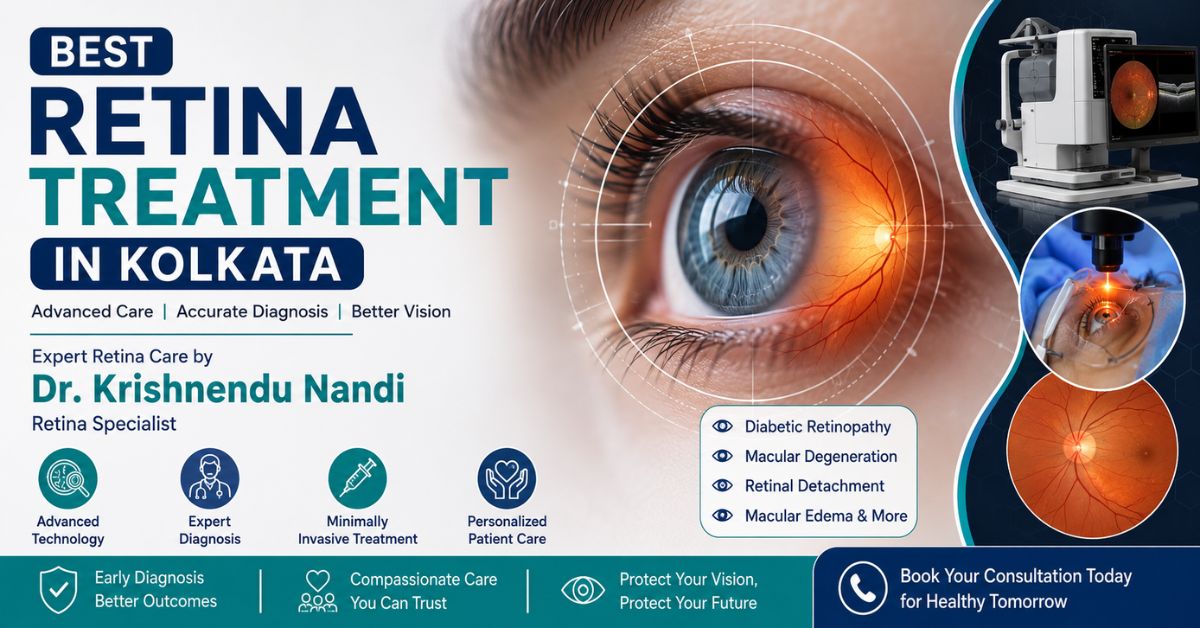
Vision is one of the most valuable senses, allowing people to experience the world with clarity and confidence. At the center of healthy eyesight is the retina, a delicate layer of tissue located at the back of the eye. It captures light and sends visual information to the brain, making it possible to see colors, recognize faces, read books, and perform everyday activities.
Unfortunately, retinal diseases often develop silently and may not cause noticeable symptoms in their early stages. By the time vision changes become obvious, the damage may already be significant. This is why choosing the best retina treatment in Kolkata is essential for early diagnosis, timely intervention, and long-term vision preservation.
Dr. Krishnendu Nandi provides comprehensive retina evaluation and personalized treatment plans for patients suffering from diabetic retinopathy, retinal detachment, macular degeneration, macular edema, retinal vein occlusion, and other retinal disorders. With modern diagnostic technology and evidence-based treatment approaches, patients receive care designed to protect and improve their vision.
The retina is a thin, light-sensitive tissue that lines the inner surface of the eye. It functions much like the sensor inside a digital camera, capturing light and converting it into electrical signals that travel through the optic nerve to the brain.
A healthy retina is responsible for:
Even a small retinal problem can significantly affect daily activities such as reading, driving, using a mobile phone, or recognizing loved ones.
Many people assume that blurry vision is simply caused by age or the need for new glasses. However, retinal diseases can progress rapidly without causing pain or discomfort.
Ignoring symptoms may result in:
Routine retina examinations allow specialists to detect problems before irreversible damage occurs.
Several retinal disorders affect people of different age groups. Some develop because of aging, while others are linked to diabetes, high blood pressure, trauma, or genetic conditions.
Diabetic retinopathy is one of the leading causes of preventable blindness worldwide.
High blood sugar damages tiny retinal blood vessels, causing leakage and swelling. New abnormal blood vessels may also develop, increasing the risk of bleeding inside the eye.
Regular diabetic eye screening can detect these changes before they threaten eyesight.
The macula is responsible for detailed central vision. As people age, this area may gradually deteriorate, causing difficulty with everyday tasks.
Retinal detachment occurs when the retina separates from the underlying tissue that supplies oxygen and nutrients.
This condition requires immediate medical attention.
Early surgical treatment offers the best chance of restoring vision.
A macular hole develops when a small opening forms in the center of the retina.
Patients may experience:
Advanced vitreoretinal surgery often provides excellent outcomes.
Blocked retinal veins interrupt normal blood flow and may cause retinal swelling and sudden vision loss.
Common risk factors include:
People should consult a retina specialist immediately if they notice:
Early diagnosis significantly improves treatment success.
Retinal conditions may develop because of:
Maintaining overall health can reduce the risk of many retinal disorders.
Individuals with the following conditions should undergo regular retina examinations:
Preventive eye check-ups help detect retinal abnormalities before symptoms become severe.
Modern retina treatment begins with an accurate diagnosis.
Dr. Krishnendu Nandi recommends detailed retinal evaluation using advanced imaging techniques.
Special eye drops enlarge the pupil, allowing a comprehensive view of the retina.
This examination helps identify:
OCT produces detailed cross-sectional images of retinal layers.
It is extremely useful for diagnosing:
High-resolution photographs document retinal health and allow specialists to compare disease progression over time.
This specialized investigation studies retinal blood circulation and identifies leaking or blocked blood vessels.
It is particularly useful in diabetic retinopathy and retinal vein occlusion.
The ideal treatment depends on the type and severity of retinal disease.
After a detailed examination, Dr. Krishnendu Nandi develops a personalized treatment plan that focuses on preserving vision while minimizing complications.
Laser therapy is commonly recommended for diabetic retinopathy and retinal tears.
Modern anti-VEGF medications help reduce retinal swelling and stop abnormal blood vessel growth.
These injections are commonly used for:
Most patients return home on the same day.
Vitrectomy is an advanced microsurgical procedure performed for complex retinal diseases.
It may be recommended for:
The procedure removes the vitreous gel and allows the surgeon to repair retinal damage using specialized instruments.
Choosing the right retina treatment depends on the underlying eye condition, the severity of retinal damage, and the recommendation of the retina specialist. The following comparison table provides a simple overview of the three commonly used treatment options.
| Feature | Laser Retina Treatment | Intravitreal Eye Injection | Vitrectomy Surgery |
|---|---|---|---|
| Best For | Diabetic retinopathy, retinal tears, and preventing disease progression | Diabetic macular edema, wet age-related macular degeneration, retinal vein occlusion | Retinal detachment, macular hole, vitreous hemorrhage, advanced diabetic retinopathy |
| Procedure Type | Non-surgical laser procedure | Minimally invasive injection inside the eye | Advanced microsurgical procedure |
| Hospital Stay | Usually not required | Not required | Day care or 1–2 days, depending on the case |
| Procedure Duration | 10–30 minutes | 10–15 minutes | 1–3 hours |
| Anesthesia | Local anesthesia | Local anesthesia | Local or general anesthesia |
| Recovery Time | 1–3 days | 1–2 days | 2–8 weeks (varies by condition) |
| Pain Level | Minimal discomfort | Mild discomfort | Mild to moderate discomfort during recovery |
| Ideal Candidates | Patients with early retinal damage or retinal tears | Patients with retinal swelling or abnormal blood vessel growth | Patients with severe retinal disease requiring surgical repair |
| Approximate Cost | ₹8,000 – ₹25,000 per session | ₹15,000 – ₹80,000 per injection (depending on medication) | ₹60,000 – ₹2,00,000+ |
| Success Rate | High when performed in the early stages of retinal disease | Excellent disease control with regular follow-up and timely injections | High anatomical success rate for many complex retinal conditions when treated promptly |
| Follow-up Requirement | Usually 1–2 follow-up visits | Multiple injections and regular monitoring may be required | Regular follow-up visits for several weeks or months |
| Main Benefit | Prevents further retinal damage and vision loss | Reduces retinal swelling and preserves central vision | Repairs complex retinal problems and helps restore retinal structure |
There is no single treatment that is best for every patient. A detailed retina examination, including advanced imaging such as OCT and fundus evaluation, helps determine the most appropriate treatment plan.
An experienced retina specialist like Dr. Krishnendu Nandi evaluates each patient’s condition individually and recommends the most effective treatment strategy based on the diagnosis, visual needs, and long-term eye health goals.
The final cost depends on the patient’s eye condition, investigations, treatment method, and individual requirements. The following estimates are approximate.
| Treatment | Approximate Cost |
|---|---|
| Retina Specialist Consultation | ₹800 – ₹2,000 |
| Comprehensive Retina Evaluation | ₹2,000 – ₹5,000 |
| OCT Scan | ₹2,000 – ₹4,500 |
| Fundus Photography | ₹1,000 – ₹3,000 |
| Fluorescein Angiography (FFA) | ₹3,000 – ₹7,000 |
| Laser Retina Treatment | ₹8,000 – ₹25,000 |
| Intravitreal Eye Injection | ₹15,000 – ₹80,000 |
| Vitrectomy Surgery | ₹60,000 – ₹2,00,000+ |
| Retinal Detachment Surgery | ₹80,000 – ₹2,50,000+ |
| Follow-up Consultation | ₹500 – ₹1,500 |
Several factors influence the overall treatment expense:
Early diagnosis often reduces the need for extensive surgery and helps minimize long-term costs.
Prompt diagnosis offers several advantages:
Many retinal diseases can be managed effectively when detected in their early stages.
Patients searching for the best retina treatment in Kolkata look for expertise, advanced technology, and compassionate care.
Dr. Krishnendu Nandi focuses on:
Every treatment plan is customized according to the patient’s condition and visual requirements, ensuring a holistic approach to retina care.
Recovery varies depending on the type of retinal disease and the treatment performed. While some patients resume normal activities within a day or two after laser treatment or eye injections, others who undergo retina surgery may require several weeks for complete healing.
Following the retina specialist’s instructions is essential for achieving the best possible visual outcome.
Laser retina treatment is usually performed as an outpatient procedure and does not require hospital admission.
Patients should avoid rubbing their eyes and follow the prescribed eye drop schedule.
Eye injections are commonly used to treat diabetic macular edema, retinal vein occlusion, and age-related macular degeneration.
Patients should immediately contact their retina specialist if they experience severe pain, increasing redness, or sudden vision loss.
Vitrectomy is a specialized retinal surgery that requires a longer recovery period.
Depending on the condition being treated, the surgeon may place a gas bubble or silicone oil inside the eye to support retinal healing.
First Week
Two to Four Weeks
One to Three Months
Recovery differs from patient to patient, and the final visual outcome depends on the severity of the original retinal condition.
Proper aftercare plays an important role in successful retina treatment.
Patients are generally advised to:
Although not every retinal condition is preventable, several lifestyle habits significantly reduce the risk.
Poorly controlled diabetes is one of the biggest causes of retinal damage.
Maintaining healthy blood sugar levels helps protect retinal blood vessels and reduces the risk of diabetic retinopathy.
Hypertension affects blood circulation throughout the body, including the retina.
Regular monitoring and treatment help preserve long-term eye health.
A balanced diet supports retinal function.
Recommended foods include:
These foods contain vitamins and antioxidants that support healthy vision.
Regular physical activity improves blood circulation and helps control diabetes, obesity, and hypertension, all of which contribute to better retinal health.
Smoking increases the risk of age-related macular degeneration and other retinal disorders.
Stopping smoking benefits both eye health and overall well-being.
High-quality sunglasses protect the eyes from harmful ultraviolet rays that may contribute to retinal and macular damage over time.
Many retinal diseases develop silently without pain or noticeable symptoms.
Routine retina examinations help identify:
Early diagnosis allows treatment before permanent vision loss occurs.
Fact: Most retinal diseases are painless. Vision changes are often the only warning sign.
Fact: Retina laser treatment is designed to preserve vision and prevent further damage.
Fact: Diabetes, trauma, high myopia, and genetic conditions can affect younger individuals as well.
Fact: While occasional floaters are common, a sudden increase accompanied by flashes of light may indicate retinal detachment and requires urgent evaluation.
Fact: Surgery aims to preserve and improve vision, but the final outcome depends on the severity and duration of retinal damage before treatment.
The most appropriate retina treatment depends on the patient’s diagnosis. Laser therapy, intravitreal injections, and vitrectomy surgery are among the commonly recommended treatment options after a detailed retina examination.
Patients should seek immediate consultation if they experience:
Most retina procedures are performed under local anesthesia and are generally well tolerated with minimal discomfort.
Depending on the complexity of the case, surgery usually takes between one and three hours.
Although diabetic retinopathy cannot always be completely reversed, early diagnosis and timely treatment can effectively slow disease progression and preserve vision.
Most diabetic patients should have a comprehensive retina examination at least once every year or more frequently if advised by the retina specialist.
No. Cataracts, refractive errors, glaucoma, and other eye conditions may also cause blurred vision. A complete eye examination is necessary for accurate diagnosis.
Yes. Early diagnosis and prompt surgical intervention significantly improve the chances of restoring and preserving vision.
Healthy habits include:
Many health insurance policies cover medically necessary retina procedures and surgeries. Coverage depends on the specific policy terms and conditions.
Patients searching for the best retina treatment in Kolkata often look for experience, technology, personalized care, and long-term support.
Dr. Krishnendu Nandi follows a patient-centered approach that emphasizes:
Every treatment recommendation is tailored according to the patient’s retinal condition, overall health, and visual needs.
Healthy vision depends on a healthy retina, and even minor retinal changes should never be ignored. Conditions such as diabetic retinopathy, retinal detachment, macular degeneration, and retinal vein occlusion can progress silently but may lead to permanent vision loss if left untreated.
Choosing the best retina treatment in Kolkata means selecting expert care, advanced diagnostic technology, and timely intervention. Regular eye examinations, a healthy lifestyle, and early consultation with an experienced retina specialist can make a significant difference in preserving eyesight.
Dr. Krishnendu Nandi is committed to providing comprehensive retina care through accurate diagnosis, personalized treatment plans, and compassionate patient support. Whether a patient requires routine retinal screening, laser therapy, intravitreal injections, or advanced retina surgery, early medical attention remains the most effective step toward protecting vision and maintaining a better quality of life.
Schedule Your Appointment Today:-
If you or a family member experience blurred vision, flashes, floaters, distorted images, or sudden changes in eyesight, do not delay professional evaluation. Early diagnosis and timely treatment offer the best opportunity to preserve vision and prevent long-term complications, helping patients enjoy clearer and healthier eyesight for years to come.