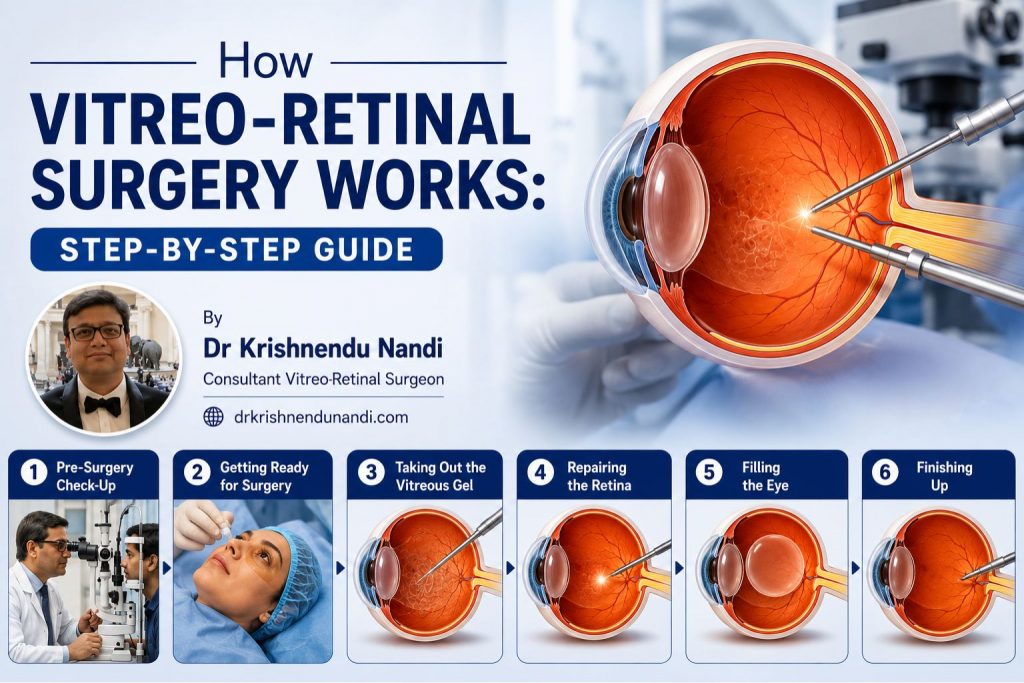
Vitreo-retinal surgery might sound complex but it is a state-of-the-art type of surgery used to treat severe conditions at the back of the eye. These affect the retina or gel-like substance (vitreous) within the eye.
Dr Krishnendu Nandi says this type of surgery can save eyesight and often even improve it if performed in a timely manner. Knowing more about the procedure can ease a patient’s anxiety and give them confidence.
Vitreo-retinal surgery is a form of eye surgery to repair issues with the retina and vitreous. The retina is a layer of light sensitive cells in the back of the eye that helps you see.
This type of surgery is used to treat retinal detachment, diabetic retinopathy, macular holes and vitreous hemorrhage. These conditions can have a big impact on vision if not treated promptly.
Your doctor may recommend vitreo-retinal surgery when other methods don’t work. You may need it if you experience:
It’s important to seek treatment early to avoid losing sight, as Dr Krishnendu Nandi explains.
The doctor will check your eyes before surgery. This might involve imaging tests to determine the problem.
This includes questions about your health and medications you’re taking. The doctor will then prepare for surgery.
In the operating room, your eye will be sterilised and anaesthetised. General anesthesia may be used in some cases, such as if you are very nervous, or if it is a complicated procedure.
Most surgeries will be performed while you are awake, but you won’t feel pain.
A key part of this surgery is known as a vitrectomy. Here, the surgeon takes out the vitreous gel. This is because the gel might be tugging on the retina or it may have blood or other debris in it that can interfere with vision. This helps the surgeon to see the retina and repair it.
With the vitreous gel out of the way, the surgeon turns his or her attention to the retina. Various methods may be used, depending on the problem.
If the retina is torn, it may be repositioned. Tears or holes may be repaired with laser therapy or freezing (cryopexy).Scar tissue is carefully removed to prevent it from putting pressure on the retina.
Once the retina is repaired, the eye is filled with a special substance to keep the retina in place as it heals. This may be a bubble of gas or a bubble of oil.
It varies from case to case. The bubble helps nestle (or tuck) the retina into the back of the eye for it to heal.
After all the steps are completed, the small instruments are taken out and the eye is patched. This procedure typically takes 1-2 hours. People can usually go home on the same day, but need to follow special post-surgery instructions.
Healing is key. You may have some discomfort, redness and blurred vision for several days. This is normal. Your doctor will give you eye drops to prevent infection and inflammation. Follow your doctor’s instructions carefully. Sometimes, particularly if a gas bubble is used, you will have to keep your head tilted for several days. This will help the retina to heal.
It can take different amounts of time for different people. Vision may improve in a few weeks for some, but can take longer for others.It’s important to keep all appointments so your doctor can track your recovery.
As Dr Krishnendu Nandi points out, recovery takes time to achieve optimal results.
Vitreo-retinal surgery is relatively safe, but can have complications. These include infection, glaucoma and cataracts. But these are uncommon with an experienced vitreo-retinal surgeon and good after-care.
Schedule Your Appointment Today:
Vitreo-retinal procedures demand precision, yet follow structured methods developed through modern advancements. Though complex in nature, clarity of outcome often follows careful execution.Early diagnosis and surgery are encouraged by doctors like Dr Krishnendu Nandi. So, if you have noticed any change in your vision, seek attention right away.
When diagnosed and treated early, many individuals will regain their sight, and return to living life to the fullest.
Dr. Krishnendu Nandi Specialist in Vitreo-Retinal diseases MS in Ophthalmology Vitreo-Retinal fellowship from Sankara Nethralaya, Chennai (Gold Medalist) Ex Associate Consultant at Sankara Nethralaya, Chennai Presently Director, Netralayam Super Specialty Eye Care Centre & Senior Vitreo-Retinal Consultant at Netralayam, VIP